 Fass- und Behälterabfüllanlagen - Fassabfüllmaschine







Automatic equipment
Fass- und Behälterabfüllanlagen
30+ years of Automatic packaging equipment experience helps smart phone production
Suche im gesamten Bahnhof
Fass- und Behälterabfüllanlagen
30+ years of Automatic packaging equipment experience helps smart phone production
In the competitive coatings industry, achieving precision, minimizing waste, and maximizing throughput are non-negotiable. The cornerstone of a profitable production line is the Paint Filling Machine—a specialized piece of equipment designed to handle everything from thin stains to highly viscous, pigmented coatings.
This guide provides paint manufacturers, plant engineers, and procurement specialists with a comprehensive overview of modern Automatic Paint Filling Machines, covering the core technologies, key benefits, and essential selection criteria to optimize your packaging operations.

Complete Ink Production Equipment
Paint and related coatings (like varnishes, sealers, and epoxies) present unique challenges due to their wide range of viscosities, tendency to foam, and abrasive nature of pigments. A reliable Industrial Paint Filler addresses these challenges, delivering critical business advantages:
| Advantage | Benefit to Production | SEO Keyword Focus |
| Accuracy & Consistency | Ensures every can, pail, or drum has the exact advertised weight/volume, minimizing costly product giveaway and ensuring regulatory compliance. | High-Accuracy Paint Filling, Volumetric Filling |
| Speed & Throughput | Automates the entire process (container indexing, filling, and capping), achieving high bags-per-minute (BPM) rates for large-scale production runs. | Automatic Paint Filling Machine, High-Speed Liquid Filling |
| Cleanliness & Safety | Utilizes specialized anti-drip nozzles and Clean-In-Place (CIP) systems to minimize spillage, reduce material waste, and limit operator exposure to chemicals. | Anti-Drip Nozzles, Industrial Liquid Filler |
| Versatility | Capable of handling various container sizes (from cans to drums) and multiple product formulas with quick changeovers. | Paint Pail Filling Machine, Custom Filling Equipment |
The core function of a paint filler is dosing. The choice between the two main technologies—gravimetric and volumetric—depends primarily on your required accuracy and product characteristics.
This is the preferred method for the majority of the paint industry, where products are typically sold by weight.
Volumetric fillers dose product based on volume, typically using a measured dose from a piston or a controlled-flow meter.
Your production requirements dictate the level of automation needed:
To ensure longevity and maintain product quality, look for these advanced features:
The right Paint Filling Machine is an investment that pays for itself through increased accuracy, reduced labor costs, and higher production output. By carefully evaluating your product’s viscosity and density against the capabilities of gravimetric and volumetric technologies, you can select the optimal High-Speed Liquid Filling solution to keep your coatings business competitive and profitable.
Paint is a versatile chemical mixture designed to cover surfaces for protection, decoration, marking, and other specialized purposes. The paint industry relies on advanced production processes and high-quality equipment to ensure efficiency, consistency, and high performance.

The Coating Pail Drum Filling Machine from Shanghai GLZON Automation is designed for efficient, accurate, and mess-free filling of paints, coatings, and related viscous liquids into pails, buckets, and drums. Built with robust stainless steel construction and advanced weighing technology, it ensures high filling accuracy, minimizing product waste and enhancing productivity. The system is available in both semi-automatic and fully automatic configurations to meet various production needs. With user-friendly controls, quick changeover features, and easy cleaning, it is ideal for paint manufacturing plants and industrial coating production lines.
Wall Paint: Includes exterior, interior, and ceiling paints, primarily latex-based.
Wood Paint: Mainly nitrocellulose lacquer and polyurethane paint.
Metal Paint: Typically enamel paints for corrosion resistance and surface protection.
Water-Based Paint: Mainly latex paint, environmentally friendly and easy to clean.
Oil-Based Paint: Primarily nitrocellulose lacquer and polyurethane paint, offering durability and high gloss.
Waterproof Paint
Fire-Retardant Paint
Mildew-Proof Paint
Mosquito-Repellent Paint
Multifunctional Paints
Volatile Paint
Non-Volatile Paint
Transparent Paint
Translucent Paint
Opaque Paint
GLZON Group offers full design and equipment solutions for paint production lines, including water-based paint, asphalt paint, latex paint, waterproof paint, fireproof paint, and anti-rust paint, providing complete plant output solutions.
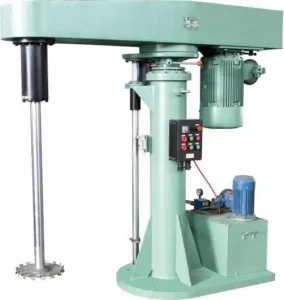
Paint mixer
Water-Based Paint Process Flow
Oil-Based Paint Production Process
Water-Based Paint Production Process
Used for pre-dispersion, stirring, high-speed dispersion, paint mixing, and color matching. Key benefits:
Handles medium to high viscosity and thixotropic materials
Ideal for batch production with fast and convenient operation
A wet grinding machine suitable for high fineness applications such as:
Coatings, inks, pigments, color pastes
Cosmetics, pesticides, and pharmaceuticals
Combines dispersion and sand grinding in one step to:
Reduce production steps
Eliminate pumps and valves
Improve efficiency and reduce material waste
A cylinder or trough with rotating blades to mix multiple raw materials. Widely used in:
Paints, inks, pigments, adhesives, and chemical products
A wet micro-grinding machine used in non-metallic mineral industries:
Paints, dyes, inks, medicines, photosensitive films, pesticides, cosmetics, and papermaking
Variants: Pin-type, disc-type, and double-cone horizontal sand mills
Agitator types include paddle, frame, and anchor designs:
Operates at low speed, can be heated
Designed for pressure operation if required
Small-scale filling equipment categorized by:
Automation: Semi-automatic and fully automatic lines
Material Nature: Explosion-proof or standard filling machines
These machines complete the production line, ensuring efficient, accurate, and safe packaging of paint products.
